
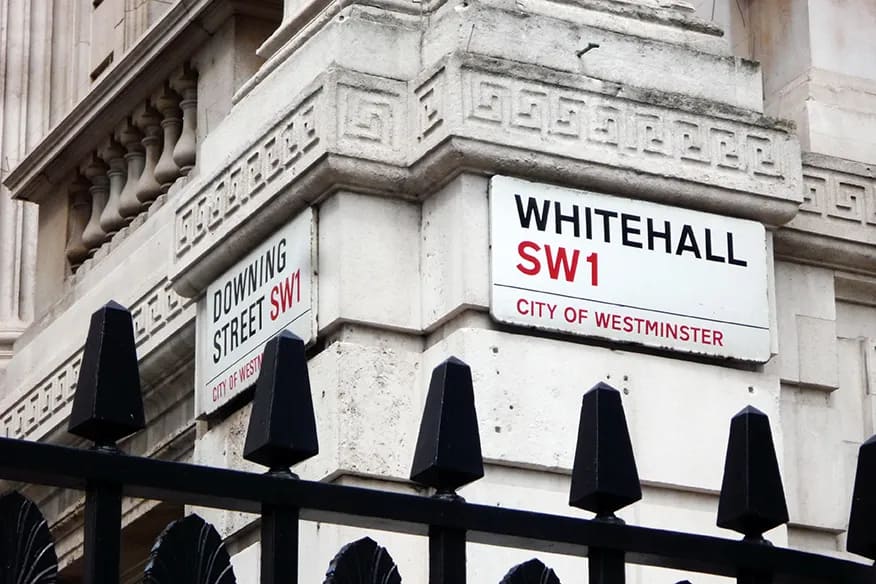
A look at the staffing backdrop, what Reform UK says it would do, and whether it would work in practice.
If you only caught today’s headlines, Reform UK’s pitch can sound deceptively simple: shrink Whitehall fast, pay “stars” more, and make officials more directly answerable to ministers. The detail matters, though — not least because the civil service has already been through a decade of churn, and because the UK’s capacity problems (backlogs, delivery slippage, fragile digital programmes) aren’t just about headcount.
The backdrop: what’s happened to civil service staffing over the last decade?
The best starting point is the basic trend line.
- In Q2 2015, ONS reported 431,000 civil servants (and 397,850 FTE) — still on the downslope from the post-2008 austerity period.
- By June 2016, staffing hit a modern low point of 384,230 FTE, according to the Institute for Government (IfG).
- After the EU referendum and then Covid, numbers rose steadily; as of June 2025 there were 516,950 FTE civil servants (IfG).
- Cabinet Office statistics show 549,660 headcount / 516,150 FTE as at 31 March 2025.
So the “ten-year story” is: a civil service that bottomed out mid-2010s, then re-expanded to meet Brexit-era policy work, pandemic delivery, and operational pressures.
What Reform UK says it would do
At today’s (16/12/2025) press conference, Danny Kruger MP said, “We are going to get this overall headcount of the centre of the Civil Service base in Whitehall back down below the levels it was at before Brexit.” He continued, “The civil service is overstaffed, badly led and underperforming.” Today’s package (and the trail of briefings leading up to it) has a few headline components:
- Cut 68,500 civil service jobs and reduce the salary bill by 17%
Reform’s “phase one” pledge is to remove 68,500 roles, arguing it would save £5.2bn a year (including £4bn in “averted salary costs” within two years and £1bn in pension contributions later). - Shift rewards: smaller pension spend, bigger performance pay
The plan includes putting £500m into a bonus pot, aimed at rewarding “high-performing” staff and reducing reliance on pensions as the main retention tool. - A tougher stance on “politicisation” and the civil service code
Reform figures have talked about changing the civil service code so top officials are “directly answerable to politicians, including for their jobs,” and reframing impartiality in culture-war terms. - A ‘back to Whitehall’ estate move
Reform has also floated not renewing leases on six big Whitehall-area buildings and consolidating the “Whitehall workforce” into a smaller footprint, claiming £100m+ annual savings.
Reaction so far: unions and sceptics aren’t buying the ease of it
Civil service unions have come out hard. Prospect’s Mike Clancy called the proposals a sign Reform is “in denial about the fundamental reality of governing a modern country”. Others warn that big cuts are a quick way to reduce capability, not bureaucracy —especially when government already struggles to hire and retain specialist staff.
There’s also a practicality problem: recent governments have repeatedly promised civil service cuts and largely failed to deliver them at scale, partly because demand didn’t go away and partly because exits cost money upfront.
Feasibility check: what looks doable, and what looks like a booby trap?
The doable bits
- Estate rationalisation is plausible in principle — government is already moving in this direction in places, and lease breaks create natural decision points. But savings depend on whether you actually reduce demand for office space, not just reshuffle addresses.
- Performance management reform is also plausible — the civil service can be slow to reward excellence. In theory, better incentives could improve outcomes.
The booby traps
- Cutting 68,500 roles quickly risks hitting delivery capacity. A lot of post-2016 growth has been in operational delivery and specialist functions (digital, data, project delivery) — the very areas governments rely on to make change happen.
- “Savings within two years” depends on optimistic assumptions about redundancy costs and the idea that work simply disappears. Reform itself cites roughly £60,000 to let someone go — that’s a big cheque to write before any savings show up.
- Politicising senior appointments may feel satisfying to ministers, but it carries real downsides: loss of institutional memory, weaker challenge, more short-termism, and a higher risk of policy swinging wildly with every election. You can make the system more responsive without turning it into a spoils system.
- Replacing pensions with bonuses sounds modern, but it can backfire: it may deter exactly the “career public servants” you need in complex departments, while not fully solving the bigger problem — pay competitiveness for scarce skills.
Upsides and downsides, in plain terms
Upsides
- A sharper focus on results, fewer zombie processes, and a genuine attempt to reward strong performance.
- Potential for leaner overheads if reforms are targeted, sequenced, and paired with service redesign rather than blunt cuts.
Downsides
- High risk of capability collapse if reductions outpace simplification of what the government is trying to do.
- Upfront redundancy and transition costs, plus the temptation to replace internal capacity with expensive consultancy.
- A drift toward politicisation that could make administration louder and less effective, not more.
Further reading
Institute for Government – Civil service staff numbers and trends
Office for National Statistics – Public sector employment statistics
Cabinet Office – Civil Service workforce and reform information
Civil Service World – News and analysis on UK civil service reform
BBC News – Civil service policy and reform coverage