Nigel Farage has been a constant in British public life for more than three decades. Beyond his political persona, this article looks at what is publicly known about his private life—his background, family, relationships, and the glimpses he has occasionally allowed into his personal world.
Early background and education
Born in Kent in 1964, Nigel Paul Farage grew up in a middle-class household. His father, Guy Justus Oscar Farage, was a City stockbroker, and his mother, Barbara Stevens, managed the family home. Farage attended Dulwich College, an independent school in South London, where today boarders pay £21,422 per term. He soon developed a reputation for outspoken debate and independence of mind.
After leaving Dulwich in 1982, he went straight into the City of London to trade commodities and metals, working for firms including Drexel Burnham Lambert, Crédit Lyonnais Rouse, and Refco. Farage has said that the culture of 1980s finance shaped his views on regulation and bureaucracy.
Marriage and family
Farage has been married twice. His first marriage, to Gráinne Hayes, began in 1988 and produced two sons. The couple met under unusual circumstances: Hayes, an Irish nurse, was caring for Farage in hospital after he had been run over by a car in 1985 near Orpington, Kent. Their meeting during his recovery led to marriage a few years later; the couple later divorced.
In 1999, he married Kirsten Mehr, a German national who worked in public relations, and they have two daughters. Mehr supported Farage’s work for years, managing correspondence and schedules. The couple lived in Kent for a long period but have since separated. Reports suggest Mehr remains in Kent, while Farage spends more time in London. He has repeatedly said he tries to keep his children out of the spotlight and that families “didn’t sign up for politics.”
Annabelle Fuller
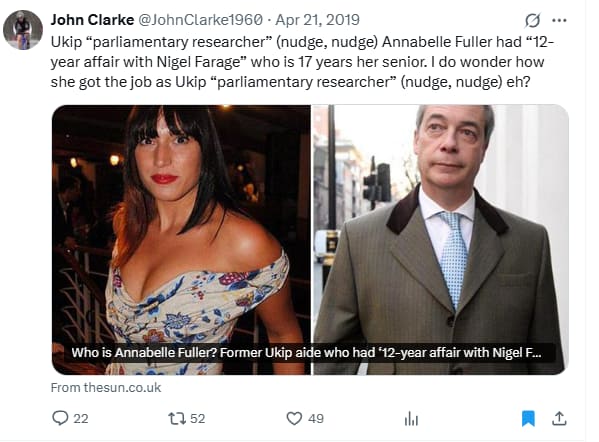
Another figure who has appeared in reports about Farage’s personal life is Annabelle Fuller, a former press aide and media adviser during his UKIP years. Fuller worked closely with Farage in the early 2000s and was part of his inner communications circle. The relationship between the two drew tabloid speculation at the time, which both denied.
Fuller later moved into writing and broadcasting. In interviews she reflected on the pressures of life inside politics and the intense scrutiny that followed, describing difficult periods driven by false or exaggerated stories. Farage has generally avoided public comment on those episodes, saying personal matters should remain private. Reports in later years suggest both moved on professionally after a period marked by media intrusion.
Relationship with Laure Ferrari
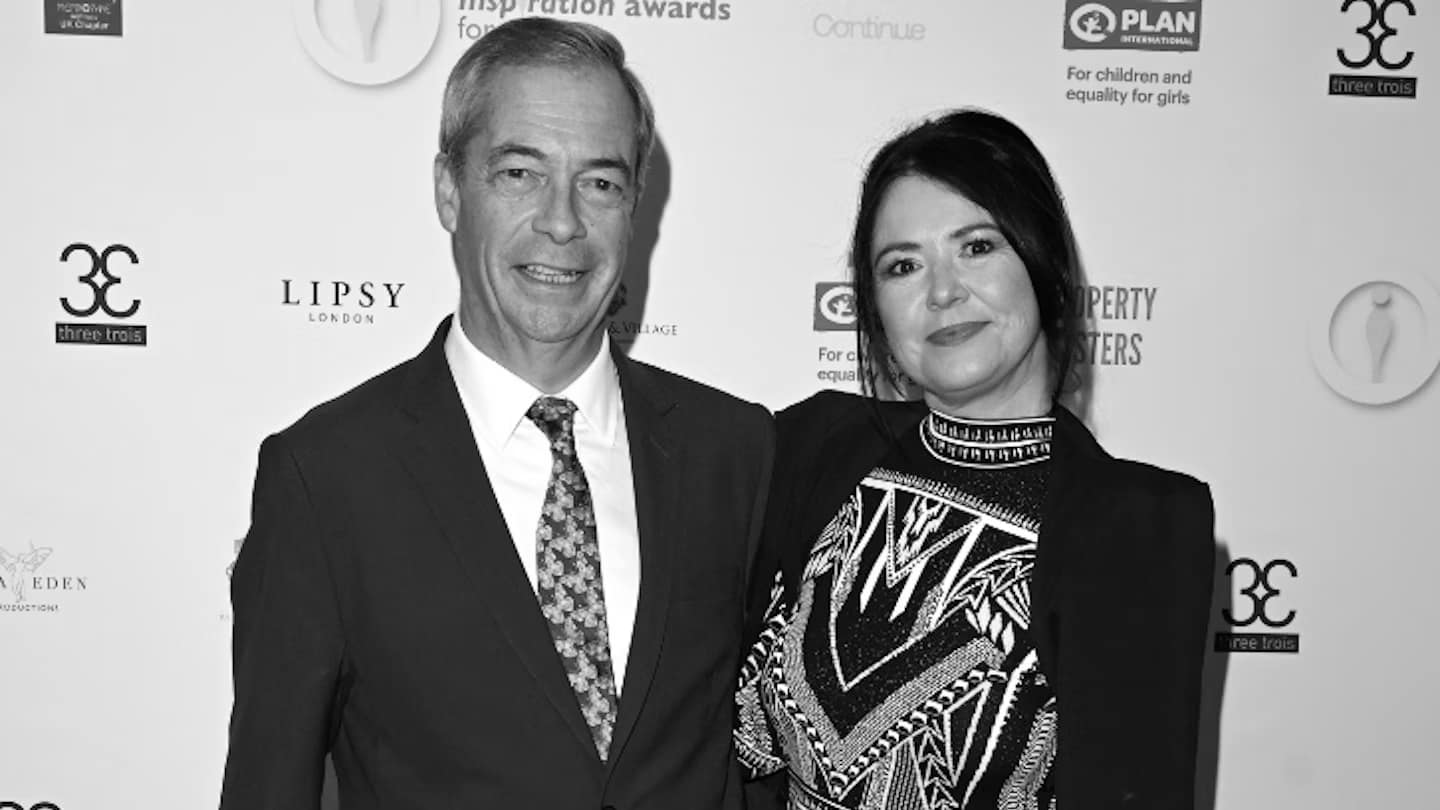
Farage’s most publicised relationship in recent years has been with Laure Ferrari, a French political activist and former parliamentary aide. They met through work in the European Parliament, where Ferrari assisted members of the Europe of Freedom and Direct Democracy (EFDD) group, which Farage co-chaired. Ferrari later directed the Institute for Direct Democracy in Europe (IDDE). Media speculation surfaced from 2014, when Ferrari moved to the UK and was occasionally seen with Farage at events. Both have described their connection as a long-standing friendship formed through professional collaboration.
The Evening Standard has reported that the pair have been close for several years and that Ferrari is a significant presence in Farage’s personal life. Friends portray her as discreet and politically savvy. While Farage’s public rhetoric often emphasises national identity, his personal circle—including European colleagues like Ferrari—paints a more cosmopolitan picture.
Health and accidents
Farage’s life has been marked by serious health challenges and brushes with mortality. In 1985, at 21, he was diagnosed with testicular cancer and later wrote about the experience in his autobiography. That same year, he was struck by a car while crossing the road after a night out, an incident that led to his meeting with Gráinne Hayes during his recovery. In 2010, he survived a light-aircraft crash on election day when a banner became entangled with the plane. Contemporary coverage detailed the crash and its aftermath (The Guardian: initial report; The Guardian: follow-up).
Hobbies, persona and media image
Outside politics, Farage emphasises traditional English pastimes—pub culture, beer, cigars, fishing, and cricket. Images of him with a pint have become part of his political branding: supporters see authenticity, critics see calculation. His broadcasting roles have kept him in the public eye and helped sustain a cultural presence beyond party politics. For a broad profile overview, see BBC News: Nigel Farage profile.
Public scrutiny and privacy boundaries
Farage has long argued that the press should draw a line between public and private life. He often deflects personal questions with humour, and major outlets generally report only facts he has placed on record. Friends describe him as sociable but protective of his inner circle—aware that any detail can be reframed through a political lens. For recent context on how his public persona intersects with media coverage, see The Guardian’s reporting.
Final thoughts
Nigel Farage’s private life remains largely self-managed—revealed in fragments rather than headlines. The publicly known facts—his marriages, friendships, accidents, and personal habits—outline a man who guards his boundaries despite decades in the limelight. In an age of relentless exposure, he has mastered selective openness, turning privacy into part of his public persona: accessible enough to seem familiar, yet elusive enough to remain intriguing.
