
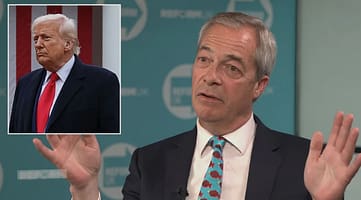
Farage Trump links are under increasingly close scrutiny with Farage now seen as a credible possibility for future UK PM, and across the Atlantic Trump’s behaviour becomes increasingly unpredictable and concerning.
Nigel Farage didn’t just admire Donald Trump from a distance. He hitched himself—repeatedly, publicly, and with obvious enthusiasm—to the Trump brand. For a while, that looked like a political superpower: a transatlantic validation of the insurgent right, a shared playbook of border politics and culture-war provocation, and a mutual sense that “the establishment” was there to be beaten, not bargained with.
But brands travel. And in British politics, Trump’s brand travels badly.
The question for Reform UK isn’t whether Farage can name-drop Trump. It’s whether he can stop Trump from becoming a drag anchor—especially as the UK heads toward the long run-up to the 2029 general election, and especially now Trump’s second-term foreign policy is producing headline events British voters may see as reckless, destabilising, or outright illegal.
2016: Brexit, Trump’s win, and the birth of a political “special relationship”
The Farage–Trump bond was forged in the emotional heat of 2016: the Brexit vote in June and Trump’s election in November. Both campaigns ran on a blunt populist pitch—national sovereignty, immigration control, suspicion of technocratic elites—and both drew energy from the promise that history could be “taken back” by force of will.
Farage moved quickly to place himself inside Trump’s orbit. Days after the election, he travelled to New York and met Trump at Trump Tower, an encounter also reported as Farage becoming the first British politician to meet Trump after the election.
Then came the moment that turned chumminess into a political headline: Trump floated Farage as a possible UK ambassador to Washington, an idea the British government swiftly rejected as there was “no vacancy”. The episode mattered because it signalled how Trump saw Farage: not as a quirky British outsider, but as a fellow traveller.
2017–2020: Trump’s first term, and Farage doubles down
Trump’s first term rapidly became polarising in the UK, where large protests and political distance were common. That should have been Farage’s cue to tactically downshift—to keep the relationship warm, but less central.
Instead, he leaned in.
By 2020, Farage wasn’t merely defending Trump from Britain—he was speaking at a Trump rally in Arizona, praising him in language that made clear this was not a casual acquaintance.
This mattered for two reasons: it made the association unmistakably voluntary, and it tied Farage’s identity to Trumpism rather than just “outsider politics.” There’s a difference between “anti-establishment” and “Trump-aligned.” British voters often accept the former; many recoil at the latter.
British public opinion: Trump is deeply unpopular
Here is the hard reality Reform UK has to navigate: Trump is widely disliked in Britain. A YouGov Europe-wide snapshot from December 2025 found that 77% of Britons held an unfavourable view of Trump, with only 18% favourable.
That’s not a marginal image problem. It’s a structural one.
And it shows up in reactions to high-profile Trump moments. On the question of Trump’s 2025 state visit, YouGov found sizeable public discomfort, with nearly half saying the invitation was wrong and only a minority expecting it to improve UK–US relations.
Yes, there are pro-Trump pockets in the UK—often overlapping with older, more Leave-friendly voters—but Reform cannot win power by assembling a fandom. It needs a coalition. And Trump is not a coalition-builder in Britain.
2024: Trump returns—and Farage makes him central again
Farage’s return to frontline electoral politics in 2024 was meant to mark a shift from insurgent to parliamentary force. Yet during the US election season that year, Farage again placed himself in Trump’s political theatre, meeting Trump backstage and talking up the implications of a Trump victory.
Strategically, this is the trap: the more Farage seeks stature by standing next to Trump, the more he imports Trump’s liabilities into British domestic politics. Unlike in 2016, those liabilities are now well understood by the public.
January 2026: Venezuela, military force—and the problem with “unorthodox”
Now we arrive at the moment that sharpens the “Trump problem” into something immediate: Trump’s military action in Venezuela.
UK reaction has been tense and politically complicated. Reuters reported that Keir Starmer said it was for the US to justify its actions, emphasising international law as the framework—without a full-throated endorsement.
The episode also triggered warnings and scrutiny about legality and precedent, including in the Financial Times, while analysis from Chatham House noted the awkward bind this creates for US allies.
Public opinion looks grim for Trump here too. YouGov polling from January 2026 showed Britons disapproved of the US action by more than two-to-one.
And Farage? He responded in a way that perfectly summarises the dilemma, describing the actions as “unorthodox and contrary to international law” while implying they might still be beneficial.
This is where association becomes a political bill coming due. British voters can tolerate a maverick. What they struggle with is a politician who seems to treat “contrary to international law” as a footnote—especially when the footnote involves military force, sovereignty, and the rules-based order Britain publicly claims to uphold.
Looking to 2029: how the Trump problem could cap Reform UK
Looking toward the next general election (due by 2029), there are two broad pathways—and both create risk for Reform.
If Trump stays unpopular and keeps generating headline crises, Farage’s long association becomes a standing vulnerability. Labour and the Conservatives wouldn’t need to invent an attack line; they’d simply replay Farage’s own words, photos, and appearances as proof that Reform’s leader is politically and ideologically aligned with a figure most Britons dislike.
Alternatively, Farage could attempt a pivot—reframing his Trump ties as pragmatic diplomacy. But the record is affectionate, not merely transactional. A messy pivot risks looking like opportunism: alienating the pro-Trump slice without convincing the sceptical majority.
The deeper point is this: Reform UK’s path to real power requires normalisation—persuading cautious voters that Reform is serious, competent, and UK-rooted. Trumpism pulls in the opposite direction. It makes everything feel louder, riskier, and less British.
Farage’s gift has always been political instinct—knowing where the mood is moving and getting there early. The danger now is that his instincts about Trump are stuck in 2016: a time when Trump symbolised disruption with plausible upside. In 2026, for many British voters, Trump symbolises disruption without the upside.
That’s the Trump problem. And unless Farage can solve it, it may solve Reform—by capping its appeal long before polling day in 2029.